Home › Curriculum
Three sessions. Pick the one that fits your room.
Every program runs in a single existing after-school block, with the same three instructors, the same safety rules, and the same cost to you, which is nothing. What changes is the subject and the space it needs.
Choosing between them
The short version
If you have a normal classroom with tables, you have two choices. The Trap Room is the one to run if your students have never wired anything. Circuit City is the one to run if they have, or if you want the session that connects to how the power grid actually works.
If you have a gym, a cafeteria or a field, The Flight Deck is the better use of that space. It uses no electricity at all and it lands well with students who have decided they are not electronics people.
Every student leaves with something they built: a mini alarm, a pocket light, or a plane. The Trap Room asks least of the building, so schools running more than one usually start there.
At a glance
One-page infographics
Each program on a single printable page: time, team size, safety, supervision, space, scoring and what goes home. Forward any of them to your principal as-is.
The Trap Room
A ninety-minute session in electronics. Teams of three or four rig a doorway with a hidden pressure plate and a trip wire, wire both to one buzzer, and then try to catch an intruder three different ways.
What they build
Two traps on one buzzer. The pressure plate is two foil-covered cardboard squares held apart by sponge strips, so a footstep closes the gap. The trip wire is a clothespin with foil on its jaws and a cardboard tab between them, tied to fishing line across the doorway at ankle height.
Wired side by side, either trap sets off the buzzer. Then an Atlas volunteer walks through three ways, and teams find out which of their traps actually catches people.
What they walk away understanding
- A circuit is a loop, and a switch is just a gap you can close.
- Two switches side by side (parallel) means either one works. In a line (series), both are needed at once.
- A trap that is too sensitive gives false alarms, and people learn to ignore it.
How the session runs
- Build the plateFoil, cardboard and sponge strips become a pressure plate that closes when stepped on.
- Build the trip wireA clothespin switch with a pull-out tab, tied to fishing line across the doorway.
- Wire both to one buzzerFive clip leads, no soldering. Teams test that each trap beeps on its own.
- Intruder walksThree walks per round: straight through, a long step, and along the edge of the frame.
- Fix window and round twoTen minutes to move the plate or re-run the line, then the walks again.
- Build one to keepIn the last ten minutes every student builds a mini alarm of their own: a buzzer, a coin cell and a trip switch.
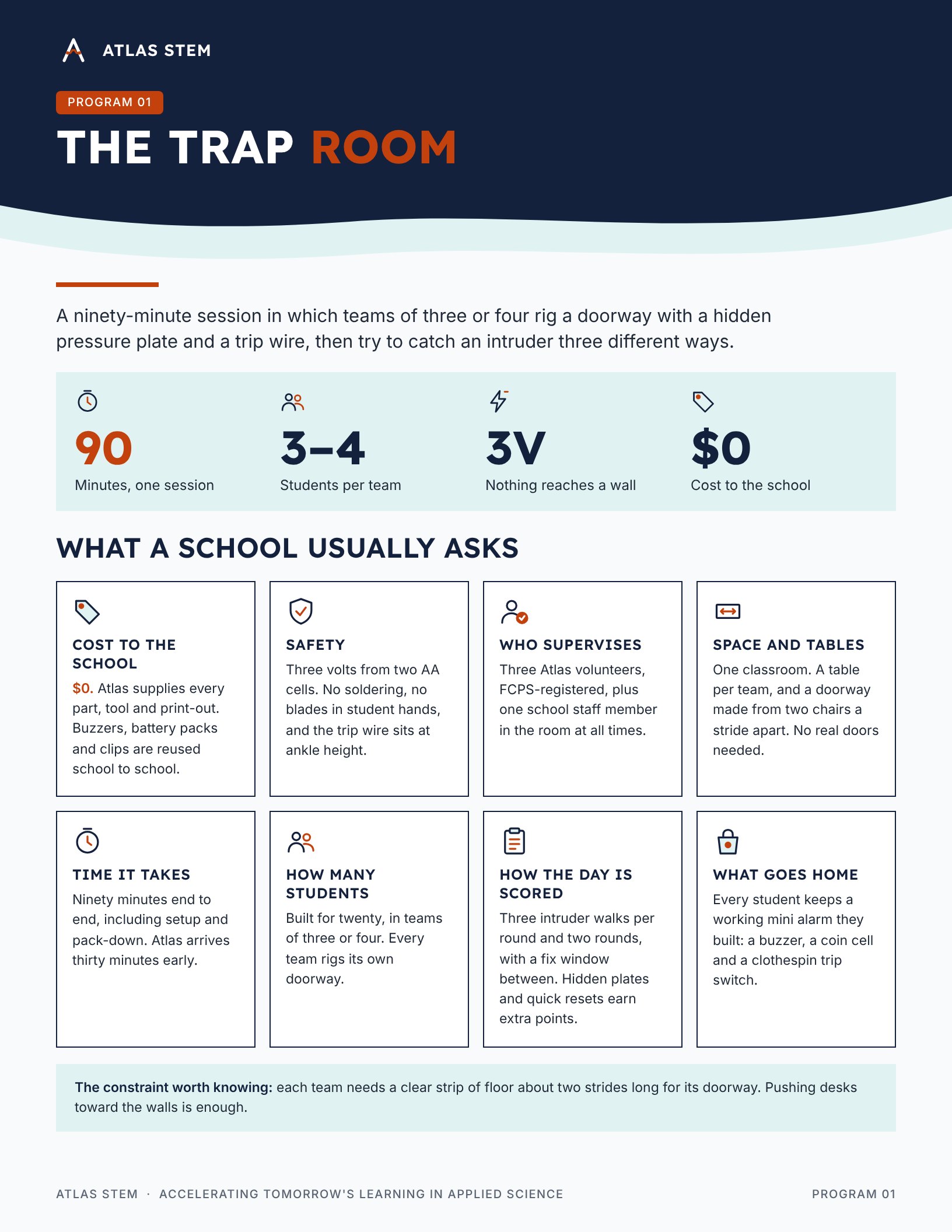 InfographicOne page, PDF
The one-page infographic answers what a school usually asks: cost, safety, supervision, space, time, group size, scoring and what goes home. Download the PDF.
Circuit City
A ninety-minute session in power systems. Teams of three wire a street of eight houses off a single battery, discover its limit by overloading it, and decide what to switch off to keep the rest lit.
What they build
A street of eight houses on a breadboard, each house an LED with its own switch, all of them fed from one battery pack through a single line resistor. That resistor is the road between the power plant and the street, and everything switched on has to share it.
Turn on all eight and every house goes dim. That is a brownout, and it is the moment the session turns from wiring into engineering.
What they walk away understanding
- Power is shared. Every house you add takes brightness from the others.
- A dim house is not a half-lit house. Delivered power is the only power that counts.
- Eight dim houses lose to five bright ones, which is load shedding, and it is what a real grid operator does on the worst day of the year.
How the session runs
- Build the railTeams wire the battery, the line resistor and the power rail that every house will hang off.
- One houseThe first LED and switch go in. It lights, and every team is on the board.
- More housesTeams add houses one at a time and watch the brightness fall as they go.
- The grid ruleA printed brightness card sets the standard. Any house dimmer than the card counts as dark.
- Two scored roundsSixty seconds held per round, with a rewire between them. Most teams run fewer houses the second time.
- Take it homeEvery student leaves with a pocket light (one LED and a coin cell) and a wiring card. Boards and packs go on to the next school.
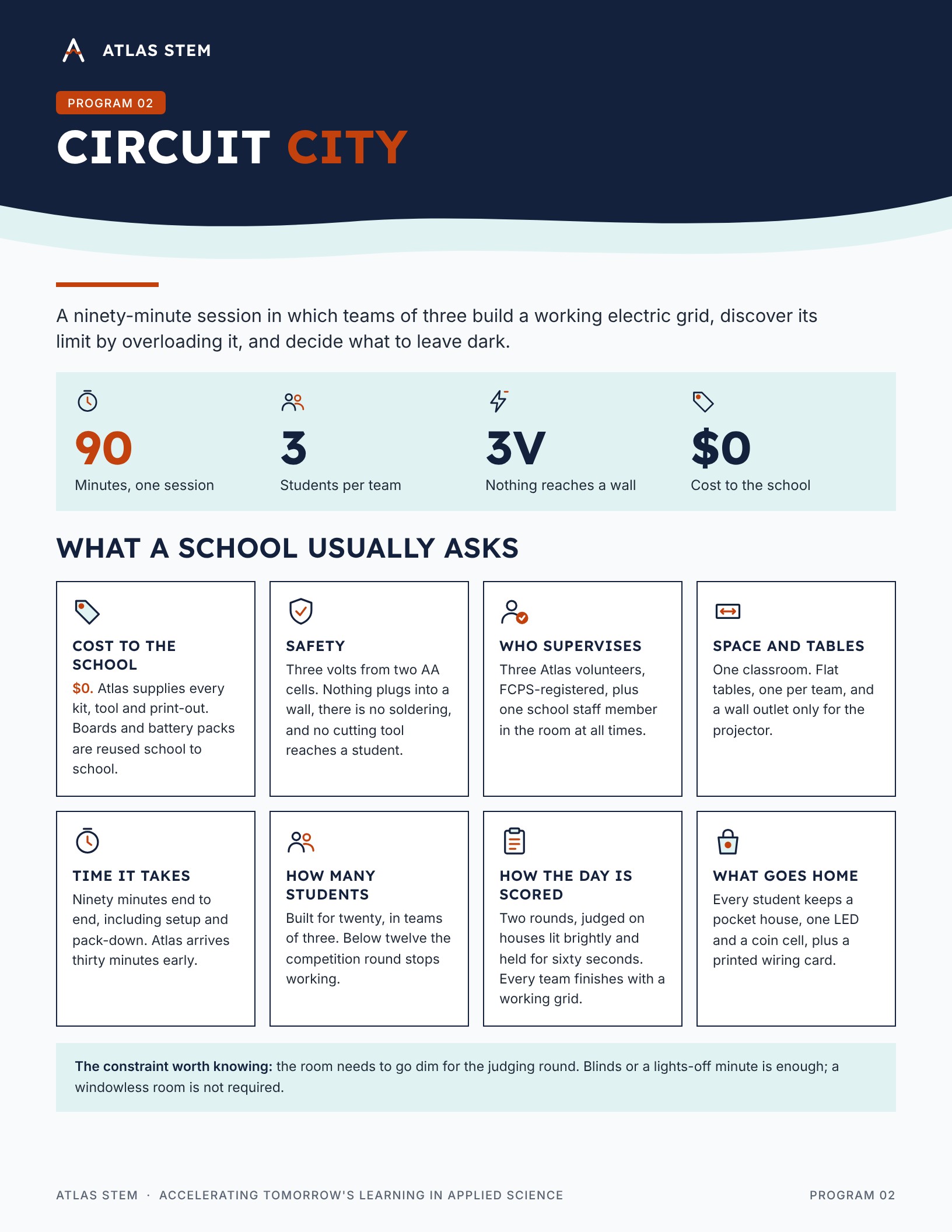 InfographicOne page, PDF
The one-page infographic answers what a school usually asks: cost, safety, supervision, space, time, group size, scoring and what goes home. Download the PDF.
The Flight Deck
A single after-school session in flight. Every student builds their own rubber-band powered plane, trims it between throws, and flies it for distance and for time aloft.
What they build
Each student assembles their own plane from a pre-cut kit, so nothing is cut during the session and nobody shares a build. A plane you did not make yourself is not yours to take home.
Flying is done in pairs. One student winds and launches, the other times the flight and marks the landing. They swap for the second plane, which means the student who is not flying still has a job.
What they walk away understanding
- A wound rubber band stores energy as twist, and more turns means more flight until the band gives out.
- Distance and time aloft pull against each other. The trim that wins one loses the other.
- A plane that dives is not broken. It is a plane nobody has trimmed yet.
How the session runs
- BuildEach student assembles their own plane from a pre-cut kit. No cutting happens in the room.
- Trim flightsShort unscored throws. Students bend the tail and shift the wing until the plane flies level.
- Wind and flyPairs split the job. One winds and launches, one times the flight and marks where it lands.
- Fix windowFifteen minutes to re-trim, repair or move the wing before anything counts.
- Scored flightsThree flights for distance and three for time aloft, scored out of one hundred points.
- Take it homeEvery student leaves with their plane and a card showing how to re-trim it.
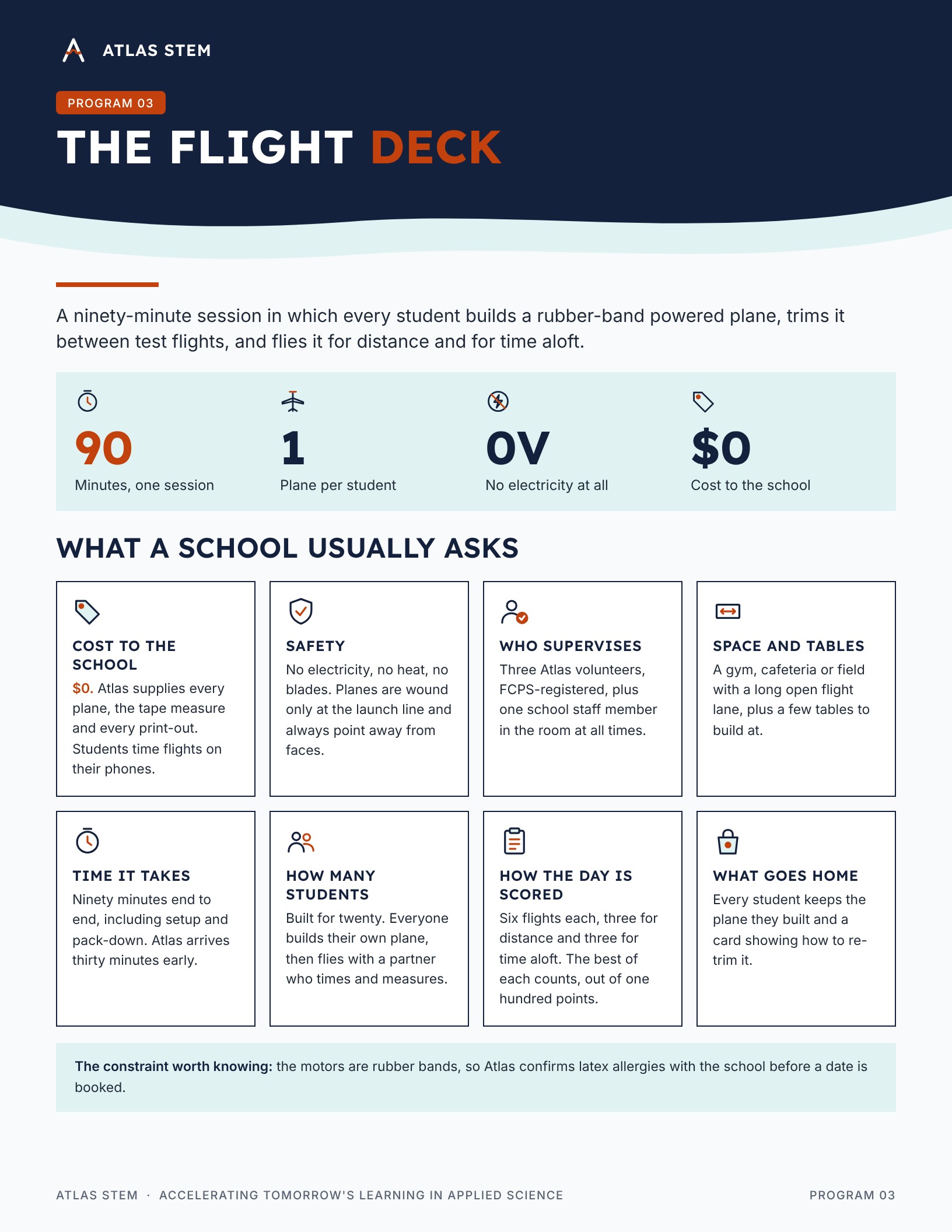 InfographicOne page, PDF
The one-page infographic answers what a school usually asks: cost, safety, supervision, space, time, group size, scoring and what goes home. Download the PDF.
Side by side
Where the three differ
| 01 The Trap Room | 02 Circuit City | 03 The Flight Deck | |
|---|---|---|---|
| Subject | Circuits, switches and parallel wiring | Power systems and the grid | Flight and stored energy |
| Room needed | Classroom with room for a doorway per team | Classroom that can be dimmed | Gym, cafeteria or open field |
| Who builds what | Teams of 3 to 4 | Teams of 3 | Build solo, fly in pairs |
| Scored on | Three intruder walks, two rounds | Two rounds, houses lit and held | Three distance flights, three for time |
| Power | 3V from two AA cells. No mains, ever | 3V from two AA cells. No mains, ever | No electricity at all |
| Allergy note | None | None | Rubber motors. Tell us first |
| Goes home | A working mini alarm and wiring card | Pocket light and wiring card | One plane per student |
Identical in all three
What does not change
Cost and staffing
- $0 to the school and $0 to families.
- Three Atlas instructors, each with an assigned role.
- One FCPS staff member in the room for the whole session.
- Setup before the block, full teardown after it.
Safety floor
- No mains power at any point.
- No soldering and no heat tools.
- No cutting tools in student hands.
- Materials arrive pre-cut and pre-counted.
How we teach
- Build first, explain second.
- Printed build cards at every table.
- Measured tests rather than a judging panel.
- A fix window, so a failed first run is not the end.